Hotel Continental Quarterly Issue 11 Spring 2026 €8 in print · free here

Cover Story · Reportage

Notes from the third spring.

Three years into the war, a house in Berlin-Treptow keeps a door open, a kettle on, and a stage warm. A despatch from the slow business of staying awake.

A hotel not for sleeping in, but for staying awake.

Features in this issue

In this issue.

  1. Editorial

    A statement, in plain language.

    A short letter from the house — what we are doing, who we are doing it with, and why we keep the lights on.

  2. Reportage · Cover Story

    Notes from the third spring.

    A long despatch on three years of working through war from one room in Berlin-Treptow.

  3. Interview

    Reading aloud.

    Olesia Yaremchuk on her book of essays about the people in the borderlands — in conversation with Irena Karpa.

  4. Photo Essay

    How to carry a house.

    Eleven artists on what survives a move. Photographs from the studios in February, with notes from the field.

00. In this issue

Inhalt — what is in this quarterly.

Hotel Continental Quarterly · Issue 11 · Spring 2026. Eight departments, one season, one house.

  1. p.04A statement, in plain languageEditorial
  2. p.08The house, room by roomSurvey
  3. p.14What's on, this seasonCalendar
  4. p.18Open calls, currently readingCalls
  5. p.22Use the spacePractical
  6. p.26Support the housePatrons
  7. p.30VisitPractical
  8. p.32From the archive — back issuesArchive
I. Editorial · 9 May 2026 · p.04

A statement, in plain language.

We stand with Ukraine — through the war, and beyond it.

The aggression of the Russian state is directed at the people of Ukraine, at the land they live on, and at the culture that has held them for centuries. Hotel Continental is a house in Berlin-Treptow where artists displaced by that war — and others who travel here from Kyiv, Lviv, Kharkiv, Odesa — keep working. Rehearsing. Painting. Teaching. Eating together. Refusing to be quiet.

We are not a refuge in the passive sense. We are a workshop, a stage, a gallery, a garden, a kitchen and a meeting room. We are a thousand square metres on Elsenstraße that, for as long as it takes, will be open to the people whose homes are being held under fire.

The hotel sign on the building stays lit at night. Not because anyone is sleeping. Because we are not.

II. Reportage · Cover Story · p.06

Notes from the third spring.

Three years into the war, a house in Berlin-Treptow keeps a door open, a kettle on, and a stage warm. A despatch from the slow business of staying awake.

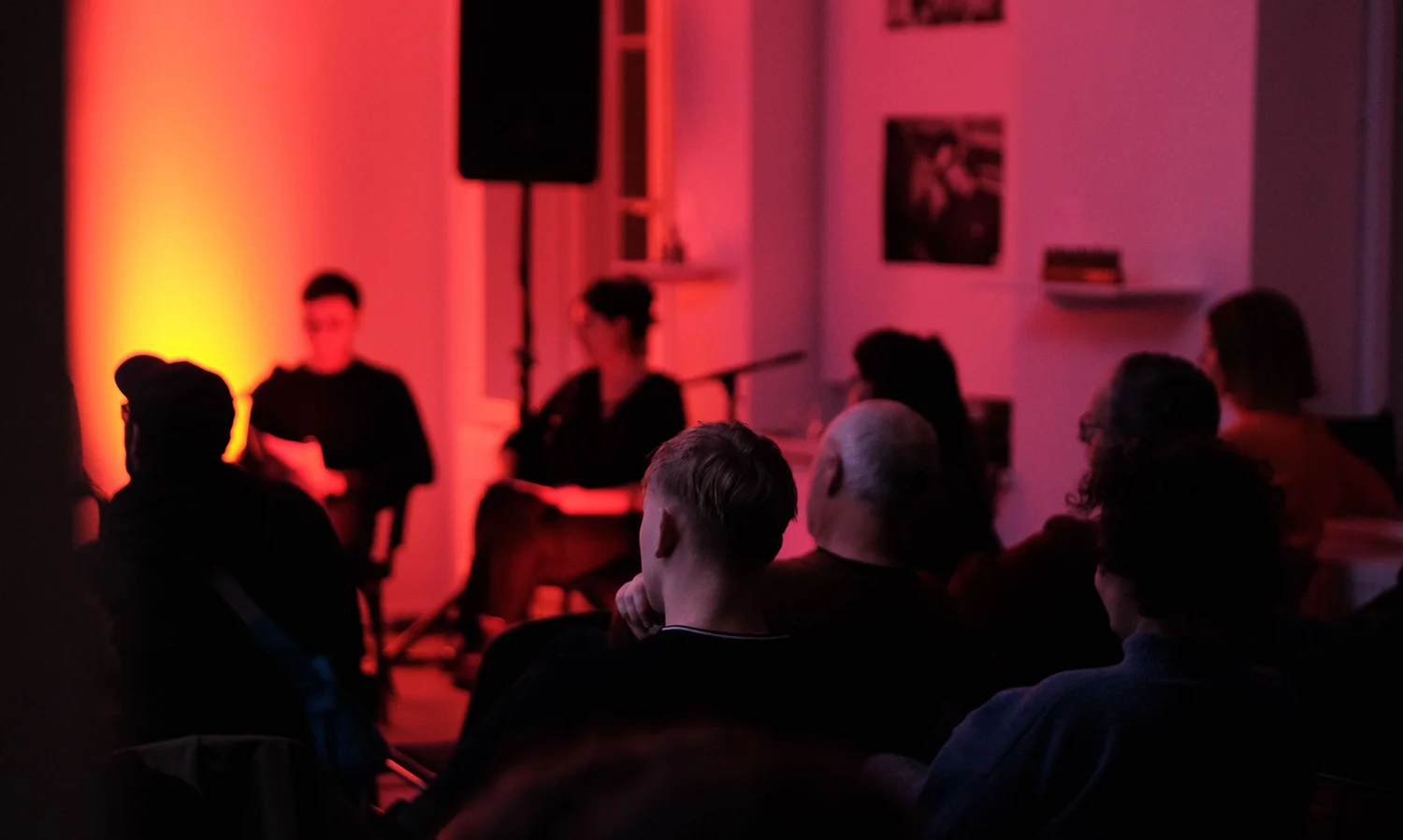
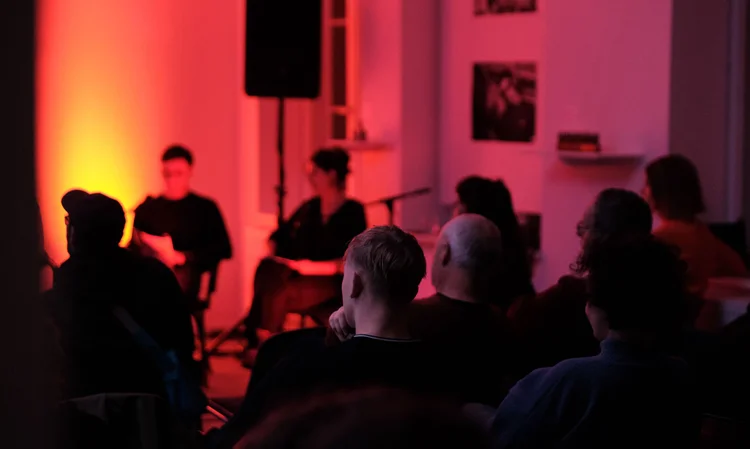
The theatre at 22:00, last Friday. Photograph: Vlad Marin.

Last spring, when the lilacs came out in Treptower Park, three of us were standing in the gallery looking at a wall of stretched canvases that had arrived from Kyiv in cardboard tubes. None of them were dry. They smelled like a workshop in a country that had not slept that week. The artist on the phone — calling from a basement in Podil, between sirens — kept apologising for the smell. We told her, in the polite way you tell people things over a bad line, that the smell was the best thing in the building.

This is the third May the Hotel has been open. We do not count from the building's birthday — the building turned ninety-two in February — but from the day the war began, plus three. That is the day we opened the door, in a hurry, with a cracked kettle and a borrowed projector and an idea that there had to be somewhere to go that was not a refugee centre and not an embassy and not a sad bar. We did not plan for the duration. No one did.

In the early months we counted everything: cups of tea, plates of borscht, sleeping bags, calls from Lviv, calls from Mariupol that didn't come through, exhibitions hung in three days, the names of people who did not come back. We stopped counting in the second autumn. It started to feel like a way of holding the war at arm's length, when the work was to bring it close. Now we count differently — residencies, rehearsals, the bills, the seedlings the neighbours bring in May.

What survives a move, in our experience, is the surprising stuff. The seedling someone's mother sent. The cassette tape from a grandmother's attic. The recipe for a soup nobody's family made any more, except the one person who left.

This issue of the Quarterly is dated May 2026, but it is in some sense about the previous Mays — the May of 2022 when the gallery walls were still raw plaster, the May of 2023 when we hosted our first wedding in the glasshouse and ran out of bread, the May of 2024 when Aglaya finished her residency and went home to Kharkiv for two weeks and came back with a suitcase of drawings of her grandmother's kitchen. May is the month the house is most itself. It is the month the doors stay open and the kitchen runs from morning to late.

Four people work here full-time. Eleven more come in for shifts. Forty-three artists have lived in our six guest studios since we opened. (We try to spell the word „studios" rather than „guest rooms" because nobody comes here to sleep, even if some do, on the floor, after rehearsals.) The kitchen team, three of them, are all Ukrainian; one of them, Iryna, was a sound designer in Odesa before. She makes the best soup in the building and runs a small Friday programme of field recordings between courses, which is how we ended up with a sound studio in Room 04.
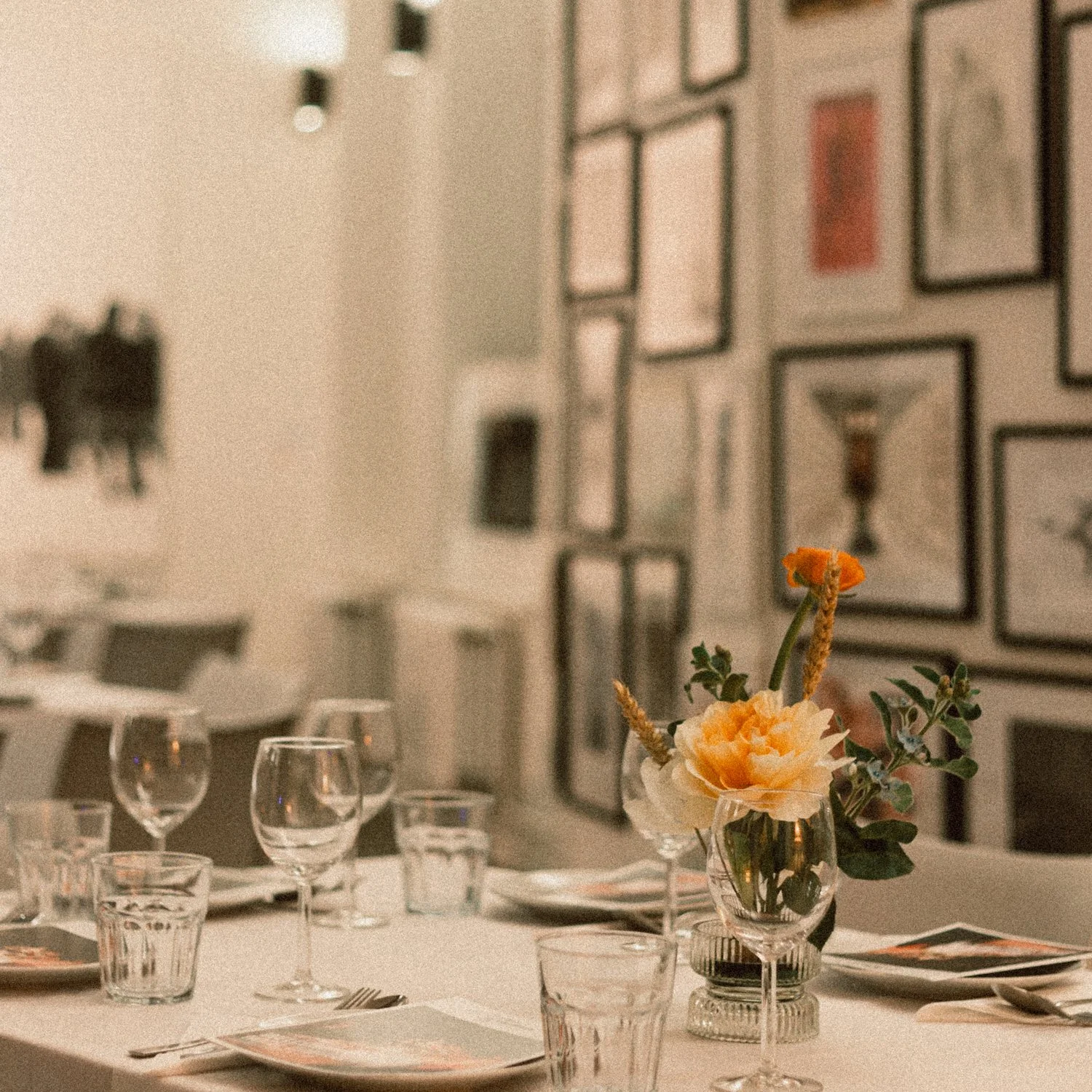
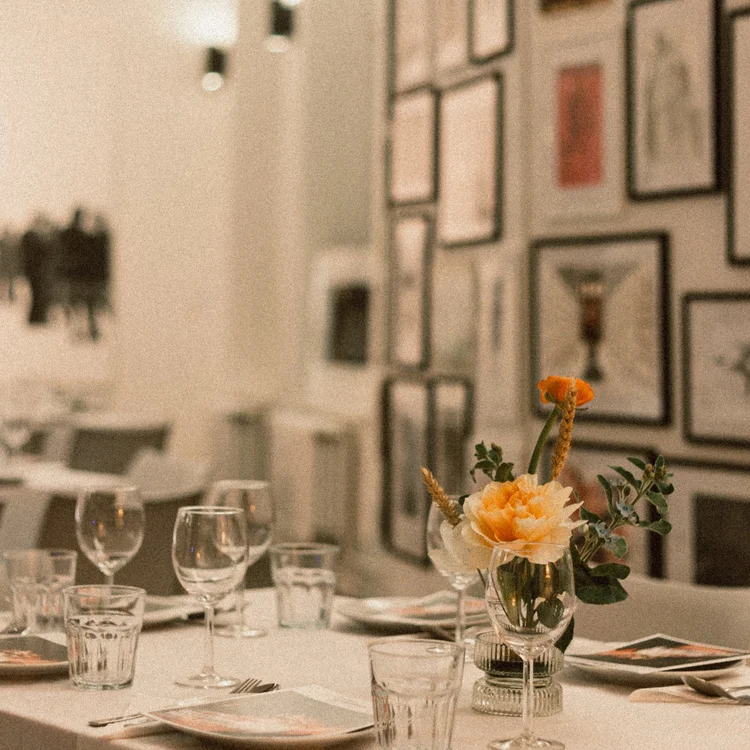
Iryna's Sunday lunch table, last week. Photograph: Vlad Marin.

Three things have changed in the last twelve months and they are worth saying out loud. We can pay artists now — small honoraria, but real ones, on time. We have a board, which we resisted for a long time and which we now find useful. And we have a print run — three hundred copies of this Quarterly, available at the bar for eight euros. The print run is what made me sit down to write this. There is something about a magazine going to a printer that requires you to commit, in a way that a website does not, to telling the truth in the same shape twice.

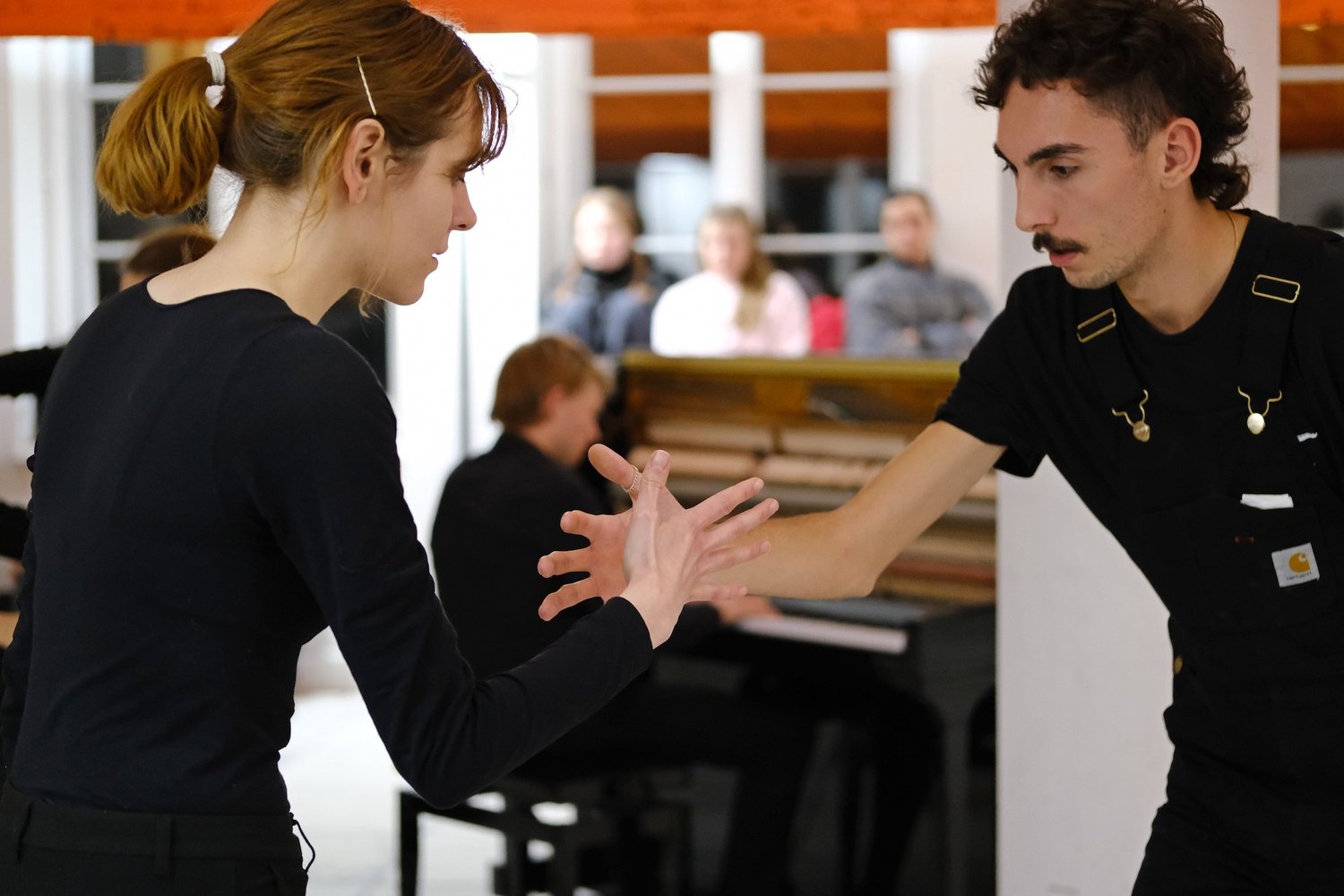
The truth, this May, is that the house is tired and the war is not over. The truth is also that there are nine residents in the building right now and that two new exhibitions open this month. Olesia Yaremchuk reads from Our Others in the theatre on the 24th; on the 31st, Dakh Daughters arrive for three days of public rehearsal. The garden is full of tomato seedlings the neighbour Frau Kühne brought, as she does every year. The hotel sign over the door — it is the original one, from 1934, with two of the bulbs replaced — is still on at night. Not because anyone is sleeping. Because we are not.

— A. P., May 2026.
Continue reading III. Reading aloud — Olesia Yaremchuk in conversation
III. Interview · p.10

Reading aloud.

Olesia Yaremchuk on her book of essays about the people in the borderlands — and what changes when you read them in a foreign room. In conversation with Irena Karpa, ahead of her reading at the Hotel on 24 May.

Olesia Yaremchuk in the gallery, April 2026. Photograph: Vlad Marin.

Olesia Yaremchuk's Our Others first came out in Ukrainian in 2018, before the war. The German edition arrives this month from Kremayr & Scheriau. The Hotel hosts the Berlin launch on 24 May, with Yaremchuk and the journalist Irena Karpa on stage. They spoke a fortnight earlier, over a slow coffee in the gallery, while Frau Kühne planted tomatoes in the courtyard.

IK · Olesia, you wrote this book before the full-scale invasion. Reading it now, in 2026 — does it feel like a different book?
It feels like the same book, written by someone who didn't know what was coming. That's not always a bad thing. The people I interviewed — the Hutsuls, the Vlachs, the Greeks of Mariupol, the Crimean Tatars — they were teaching me, even then, how a culture survives when the state around it changes. I thought I was writing about minorities. I was writing about all of us.
IK · The German edition has new material. What did you add?
A short afterword from Lviv, written in the spring of 2024. I rewrote it three times. The first version was angry; the second was tired. The third version is the one I wanted to publish. It says something simple — that „other" is a word the empire uses, and that we are not other, we are here. That's all.
IK · You're reading at the Hotel Continental on 24 May. Why this place?
Because the people who run it are people I know. Because the theatre has a wooden floor and the kitchen has Iryna in it. And because reading a book in a foreign room is a very specific feeling — you can hear the foreign room listening. I wanted that.
IK · What does the Hotel mean to you, as a Ukrainian writer in Europe right now?
It means I can be a writer first and a Ukrainian second. That sounds small. It is enormous. Most rooms I read in, I have to be Ukrainian first — to explain, to defend, to translate. Here I just have to read. The translating happens around the work, not on top of it.
IK · Is it easier to write now, or harder?
Both. The material is everywhere. The language has slowed down. I write by hand again, because typing made me too fast. The afterword I mentioned — I wrote it on the train from Lviv to Kraków, in pencil, on the back of a printout of someone else's poem. I think the printout was a Stus. I don't remember.
IK · A question we ask everyone we interview in this issue: what survived your last move?
A wooden spoon my grandmother used. A cassette tape of Kvitka Cisyk that I haven't listened to since 2014. The address book of an editor at Tyzhden who is no longer alive. And a particular kind of stubbornness, which I had as a teenager and lost in my twenties and got back in February 2022 and have not yet put down.
IK · One last thing. What are you reading?
Vasyl Stus. Who else, in May.

Olesia Yaremchuk reads from Our Others on 24 May 2026, 19:30, in the Theatre. Pay-what-you-can. The book is available at the bar after the reading.

Continue reading IV. How to carry a house — a photo essay by Vlad Marin
IV. Photo Essay · p.14

How to carry a house.

Eleven artists were asked, in February, what they had carried with them from home. The answers, photographed in the studios in late April.

  1. i.

    A wooden spoon, brought from Lviv in February 2022, used every Sunday in the kitchen since. The handle was burnt by accident in March 2024 and she chose to keep the burn. „It is more itself now," she said.

  2. ii.

    A roll of canvas, fifteen metres of it, carried out of a studio in Kharkiv during the second week of bombardment and not unrolled until last month. There is a stain in the middle that she will not paint over.

  3. iii.

    A cassette tape from a grandmother's attic in Mariupol — a recording of weddings, dated 1979 in pencil. The grandmother is no longer alive; the cassette is the only object left from her flat.

  4. iv.

    A bundle of drawings by his daughter, age nine when they left Kyiv, age thirteen now. Some are of cats. Some are of buildings on fire. He keeps them flat in a folder under his bed in Studio 03 and looks at them, he said, „less often than I thought I would. That seems like a good thing."

  5. v.

    An apron, originally white, now mainly red, used by Iryna in the kitchen since the second month. Borscht, beetroot, on Sundays cherries. „If you wash it, it forgets things," she said. So we don't.

The full series — eleven photographs, eleven captions — is on the printed Quarterly. The print issue is at the bar.

II. Survey · p.08

The house, room by room.

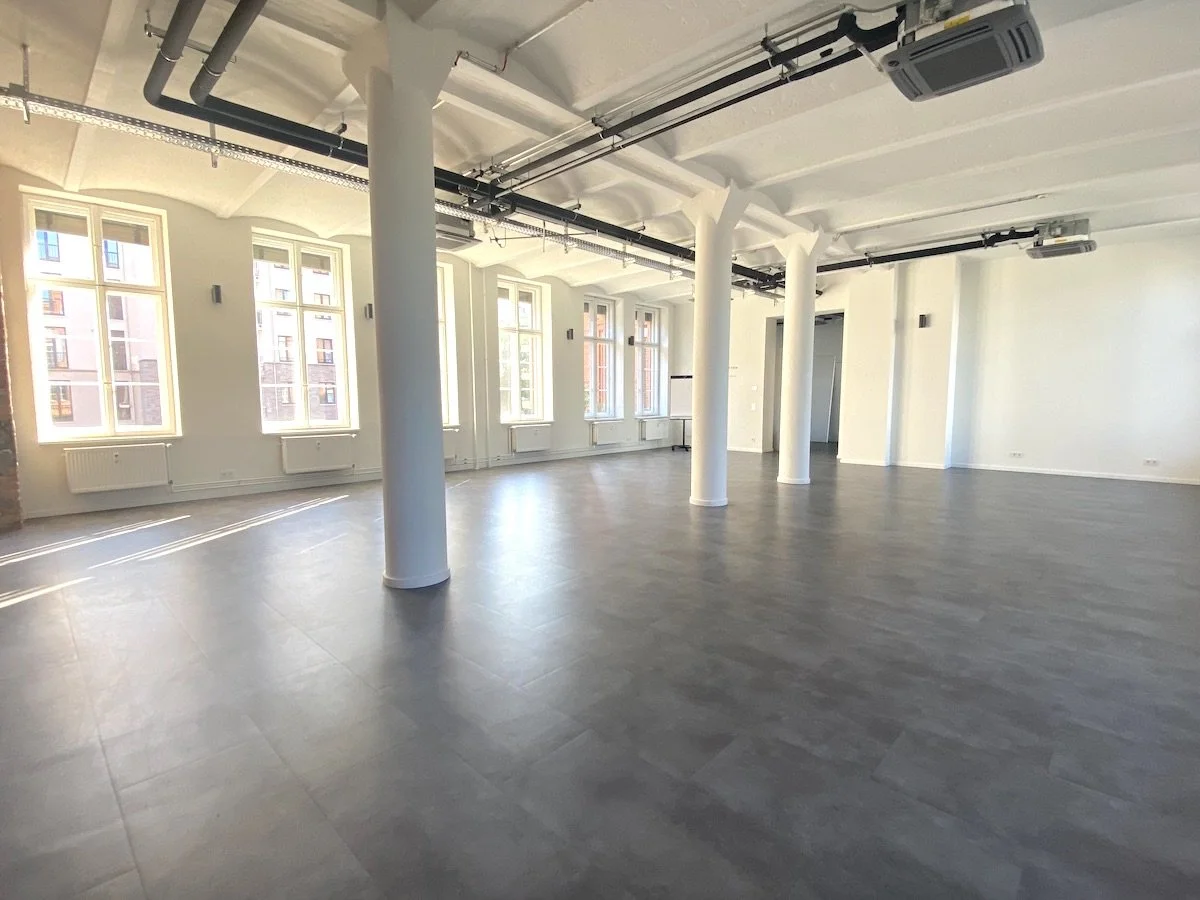
Seven rooms across one thousand square metres. Built as a hotel a century ago. Now everything but.

  1. 01

    The Theatre

    180 seats · raked · black box

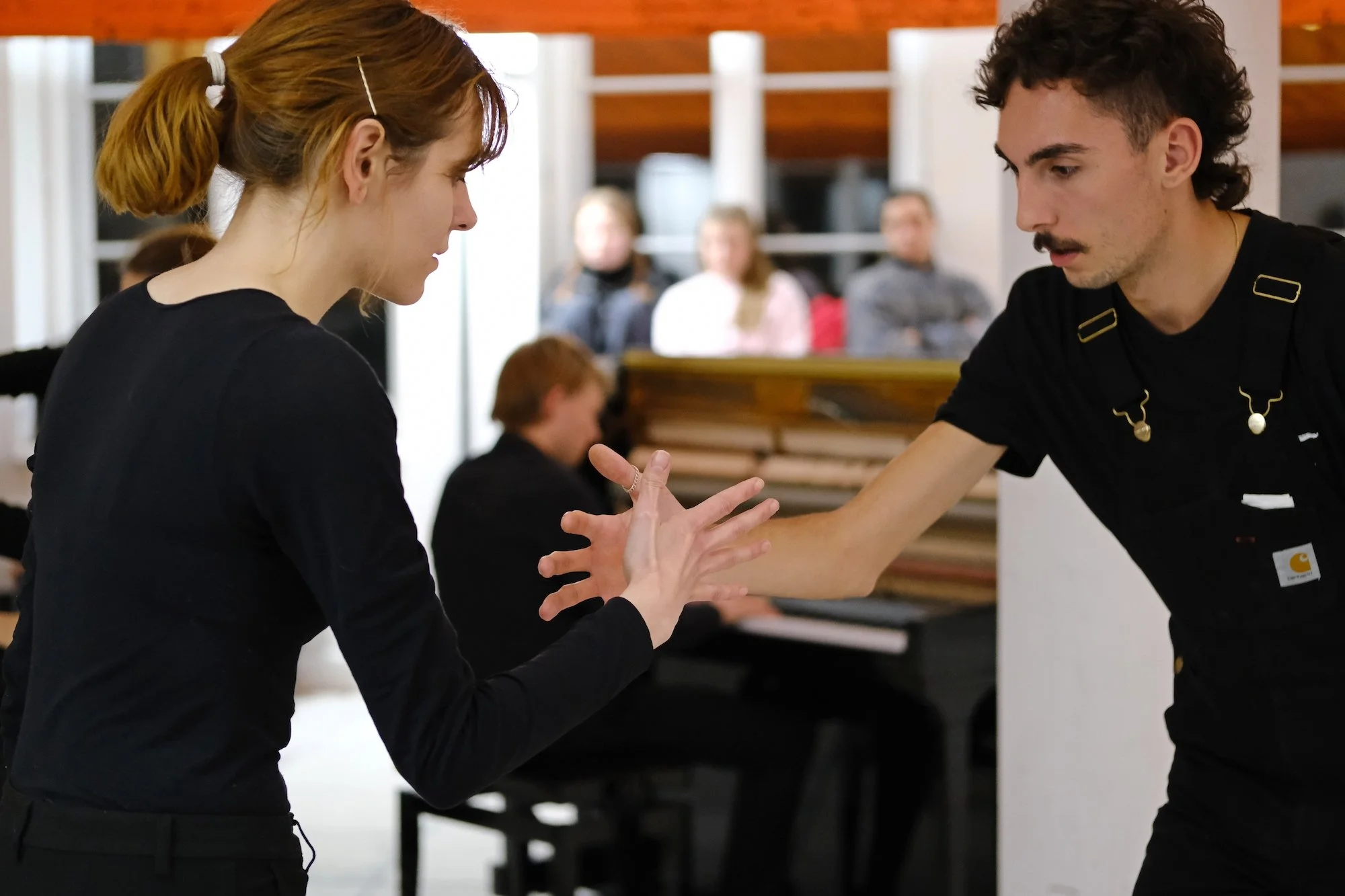
    The former ballroom, now a lighting grid and a wooden floor. Dance, readings, concerts, public rehearsals. Most evenings, the door is open.

  2. 02

    The Gallery

    240 m² · 4.8 m ceiling · daylight

    Four to six exhibitions a year, curated in-house and with guest curators. Solo shows for resident artists, group shows built around questions we can't yet answer.

  3. 03

    The Workshop

    wood · ceramics · screen-print

    Tools borrow, knowledge shared. Open to residents and to anyone who has the patience to learn from someone else. Tuesdays and Thursdays, you teach what you know.

  4. 04

    The Studio

    acoustic · 24-track · piano

    A small recording room available to displaced musicians at no cost. We do not bill for time spent making something again, somewhere else.

  5. 05

    The Glasshouse

    outdoor · seasonal · 60 standing

    A glass volume in the courtyard. Summer concerts, long dinners, occasional film screenings projected onto a sheet. In winter, lights only.

  6. 06

    The Garden

    urban · communal · always open

    We grow some of what the kitchen serves. There are benches. Blackbirds. A neighbour who brings tomato seedlings every May. The city continues outside.

  7. 07

    The Studios

    six work studios · residents · visiting artists

    Working studios for resident artists — painting, drawing, sculpture, whatever the practice asks for. A desk, a north-facing window, a sink, a key, a year if needed. The hotel sign above the door is older than any of us.

III. Calendar · p.14

What's on, this season.

A selection from the spring programme. Full calendar at the door, and on the printed sheet by the bar.

Full programme & tickets
IV. Calls · p.18

Open calls, currently reading.

V. Practical · p.22

Use the space.

The house pays its bills, in part, by being used well. Concerts, conferences, exhibitions, workshops, weddings, birthdays. Everything we earn here funds the programme.

We rent the theatre, the gallery, the glasshouse and the garden for private and public events. The building has its own bar and a small kitchen team. The rates are honest. The rooms are good.

If you are a Ukrainian organisation or initiative working in solidarity, ask. The rate is different for you.

  • Theatrefrom €420 / evening
  • Galleryfrom €380 / day
  • Glasshousefrom €260 / evening
  • Garden & Kitchenon request
  • Whole houseon request

Live availability — May & June 2026.

Tap a free date to start a booking inquiry. Bookings are confirmed by email; this is a quick view, not a binding system.

Need a longer view, or a recurring slot? Write to info@artspaceinexile.org.

VI. Patrons · p.26

Support the house.

We are funded by tickets, by rentals, by a few public grants, and by people who believe a working cultural house in Berlin is a useful answer to a war. There is no minimum. Every euro stays in the building.

€10 / month

Reader

Keeps the lights on in the gallery for one evening. Two free reading tickets per year.

€25 / month

Resident

Underwrites a residency week. Programme priority booking. Your name on the printed annual.

€100 / month

Patron

Buys a month of recording time for a displaced musician. Studio visits with the artists in residence.

Or a one-off gift

A single donation via PayPal — every euro stays in the building.

For monthly support, write to info@artspaceinexile.org — and we will set it up together.

Bank transfer (Germany / SEPA)

GiroCode QR code for SEPA bank transfer to Hotel Continental e.V.
Scan with your banking app
Account holder
Hotel Continental e.V.
IBAN
DE12 1001 0010 0000 0000 00
BIC
PBNKDEFF
Reference
Donation · your name

Hotel Continental e.V. is a registered non-profit. Donations are tax-deductible in Germany; we issue receipts on request.

VII. Practical · p.30

Visit the house.

The address

Elsenstraße 87
12435 Berlin-Treptow

S-Bhf Treptower Park · 7 minutes on foot. Ring at door 2. The hotel sign is the right house.

Hours

  • Monclosed
  • Tueclosed
  • Wed14:00 — 22:00
  • Thu14:00 — 22:00
  • Fri14:00 — late
  • Sat12:00 — late
  • Sun12:00 — 20:00

Programme nights run later. Garden open whenever the gate is.

Write to us

For press, residencies, bookings and bank transfers, the same address. We answer within a few days.

Anything else?

Same address, fewer questions.

Newsletter

VIII. Letters · responses to Issue 10 · p.31

Letters & community.

Two letters this month, lightly edited for length. We read every email; we publish a few. Send yours to letters@artspaceinexile.org.

  1. „I read your winter issue, ‘On dark winters', from a kitchen in Hamburg, while the building manager argued with the heating company on the stairs. The essay by S. about the Friday soup made me cry — not in a sad way, in the other way. We started a Friday soup in our staircase the next week. It is on its eleventh week. The manager comes."

    — K. M., Hamburg-Eimsbüttel

  2. „A small correction: in the photo essay in Issue 10, the woman seated at the long table on page 18 is not Olha, as captioned. It is Olha's sister Halyna. Olha lives in Vienna now. Halyna is in Berlin. They look very alike, but it matters to them which is which."

    — H. K., on behalf of both sisters, Berlin-Wedding

From the editor

To K. M.: thank you. We are putting your soup story in next month's print issue if you let us. To H. K.: corrected on the digital edition; the print run of Issue 10 stands as printed. We owe Halyna and Olha a coffee. — A. P.

VIII. Back issues · p.32

From the archive.

Past issues of the Quarterly, by the seasons. Print copies available at the bar; PDF in the newsletter.

  1. № 10 Winter 2025

    On dark winters

    Three essays on heat, electricity, and the kindness of evening soups.

    Read PDF →
  2. № 09 Autumn 2025

    Of borrowed homes

    Six artists on the rooms they have lived in since 2022.

    Read PDF →
  3. № 08 Summer 2025

    Heat / silence / song

    A photographic essay from the urban garden, with poems by V. Stus and L. Kostenko.

    Read PDF →
  4. № 07 Spring 2025

    The first thaw

    An interview with the kitchen team, and a list of seeds we planted that May.

    Read PDF →
Read all back issues